
Our Patriot Ancestors
"To acknowledge our ancestors means we are aware that we did not make ourselves... We remember them because it is an easy thing to forget: that we are not the first to suffer, rebel, fight, love and die." — Alice Walker
Colonel Jonathan Brewer (SAR RC 164778 or 328600?) by Jeffrey M. Brewer
Whether he was born in 1725 or 1726 in Framingham, Mass., Colonel Jonathan Brewer packed a remarkable amount of patriotism and adventure into his lifetime.
He married Frances Buckminster of Framingham in 1760.A veteran of the French and Indian War, he served as a company commander in the expedition to Quebec in 1759.
Having purchased a tavern in Waltham, Mass., in 1770, Colonel Brewer raised a regiment of 397 men in advance of The Battle of Bunker Hill and sustained a severe arm wound during the battle. This regiment was known as the "Massachusetts 13th" or "Brewer's Regiment." His regiment fought in the open on the Charlestown peninsula defending the “diagonal” between the earthen redoubt on Breed’s Hill and the rail fence to the Mystic River. His son, Francis (born 1766), a young boy during the early stages of the American Revolution, served as Colonel Brewer’s “waiter” or valet, receiving Rev War service credit. In May, 1775, he had petitioned the Provincial Congress to lead a second expedition to Quebec, but was rejected. The mission was later entrusted to Benedict Arnold.
Along with Colonel William Prescott, Colonel Brewer was among 14 officers to sign a letter of commendation recognizing the Bunker Hill contribution of black soldier Salem Poor. Under order from General George Washington, he served as a Barrack Master following Bunker Hill and later commanded a provisional regiment of artificers in 1776 as the Revolutionary War shifted to the New York-New Jersey campaign. Declaration of Independence signer Robert Treat Paine said: “That Colonel Brewer is the biggest sense (sic) man I know, but rough as a grizzly bear.”
Colonel Brewer died Jan. 4, 1784 in Waltham four months after The Treaty of Paris (Sept, 3, 1783) officially secured America’s Independence.
Moses Crawford, P-140753, by M. Brett Callaway
Moses Crawford was born in St. Mark’s Parish,Culpepper County, Virginia, in 1759. He served as Sergeant in the Virginia militia under Major Angus McDonald and Captain Hugh Stephenson during Dunmore’s War, receiving his pay at Romney, Virginia (present day West Virginia) in 1775. As many others who were paid at Romney, Moses signed up as a private for the Continential army with Captain William Croghan in February 1775. His original term was for three years. He served in the Virginia Eighth Regiment, Company Nine. Company Nine was detatched to the First Virginia for the campaign of 1776. His Company had engagements at Harlem Heights, Mamaroneck, White Plains, wintered at Valley Forge, crossed the Delaware with General George Washington’s troops to victory at Trenton. Then in 1777, still attached to the First Virginia, they fought at the Second Battle of Trenton, Princeton, and New Market. Moses may not have participated in these battles as he was listed at the May 1777 muster as “sick at Trenton.” In the summer of 1777, Moses was chosen for a special detachment of light infantry under the command of General William Maxwell, Colonel William Crawford, and Captain William Darke. As part of this light infantry, he fought at Brandywine and was wounded in the hand. While in the same detachment, Moses fought at Germantown. Back under the command of Captain Croghan, Moses fought at Monmouth Courthouse. Parts of the Virginia Fourth, Eighth, and Twelfth Regiments were combined into a newly constituted Virginia Fourth on September 14, 1778 under the command of Colonel James Wood. Moses remained under the command of Captain Croghan. Moses was part of the hand-picked raiders at the Battle of Stony Point in 1779. In 1780 he marched from winter quarters at Morristown to Charleston (“Charles Town”) through the coldest winter in a century. Moses was captured at the Siege of Charleston. The British stole his papers that entitled him to land bounties for his military service. He escaped from captivity July 27, 1780, but could not rejoin his company before Yorktown due to sickness.
In 1786 Moses married Sarah Ann Singleton. Their only known child was William Singleton Pickett Crawford. Sarah died in 1789. Now in Burke County, Georgia, Moses married again in March of 1790 to Nancy Dorsey. They had six children: John (b. 1790), Elijah, Elisha, James, Delilah, and Betsey (b. 1806). He was a poor farmer, never having received any of his land bounties. He died in Bledsoe, County, Tennessee December 17, 1826. His place of burial is not known to me.
John Darlington, P-143849, by David J. Linton, 226394
John Darlington was born at Brandywine, Pennsylvania, on August 20, 1756. He was first drafted into the Pennsylvania Militia in August 1776 at Chester County, Pennsylvania. He married Elizabeth Irwin December 20, 1780. Their known children are Jinny (born September 29, 1781), Theophilius (born January 3, 1783), Joseph (born September 13, 1784), John (born February 17, 1786), Elizabeth (born January 18, 1788), E. Mary (born July 20, 1789), Robert (born May 9, 1791), Margaret (born February 8, 1793), Abraham (born July 26, 1795) and Rebeckah (born November 9, 1799). He died January 29, 1833, at Brandywine Township, Chester County, Pennsylvania.
John Darlington was first drafted into the Chester County Pennsylvania Militia in August 1776 as a private in a company commanded by Captain Robert Lockhart as part of a Regiment commanded by Col. John Hannum and Lt. Col. Joseph Parks. The company assembled in Brandywine Township, and joined the regiment in Philadelphia, Pennsylvania, and marched to Amboy, New Jersey, where they constructed a battery. He then witnessed the battle of Long island, New York where they could see the “flashes, smoke of the guns and at times the movement of men”, but the regiment took no part in the battle. John was discharged from the service.
After his discharge and while still at Amboy, New Jersey, he enlisted in the Flying Camp for four months into a company commanded by Capt. James McClure. The company was in the regiment commanded by Col. Thomas Bull and Major Bartholomew and the Flying Camp was commanded by Gen. Ewing. The regiment marched from Amboy, New Jersey, to Bayonne, New Jersey, and then to Fort Lee. The regiment was then carried across the Hudson river to defend Fort Washington. John was posted on guard duty at Fort Lee and did not cross with the regiment. When the British attacked all of the regiment was taken prisoner and removed to New York. John, however, was again discharged from the service before Fort Washington was taken by British forces.
On August 3, 1777, he was again drafted into the Chester County Militia for two months joined a company commanded by Capt. James Robinson. His company met at Old Chester, Pennsylvania, on the Delaware river in Delaware County, Pennsylvania, where they built a battery. They then were marched to Chadd’s Ford, Pennsylvania, and were present for the battle of Brandywine Creek. After the battle they then retreated back to Old Chester, Pennsylvania, then to Darby, Pennsylvania then to Richard Thomas’s farm near Downingtown, Pennsylvania, and through other points in Chester County, Pennsylvania. John spent almost all of this enlistment on the march before being discharged for the third time.
John Darlington was drafted for his fourth term of service in 1781 into a company commanded by Capt. Robert Lockhart in a regiment commanded by Col. Robert Elton. The regiment started on the march to New York through New Jersey but never left the state of Pennsylvania. John was discharged after a month’s service.
Medad Dewey II
(P-147503) by Craig S. Isaacson (5X Great Grand Son)
Medad Dewey II was the son of Medad Dewey I (1736-1760) and Elizabeth Noble (1738-1803). Medad Dewey’s birthplace was Westfield, MA (1760) and he died in West Leyden, NY where he is buried (1849). His only known sibling was Soloman Dewey (1758- ). Medad Dewey II married Tryphena Roberts (1769-1849). Their children were Bethia (1789-1849). Amiria (1794-1822), Harvey (1795-1876), and Lemuel (1804-1858). Harvey is buried next to his parents’ grave in West Leyden, NY Cemetery.
Medad Dewey II fought in the Battle of New London, CT against the British forces led by the traitor Benedict Arnold. Patriots were forced to retreat when numerically superior forces overwhelmed them. As a result of the battle, New London was set afire by British and Loyalist troops.
Dewey II was a private in Capt. Preserved Leonard’s Company of Westfield, MA in Col. Elisha Porter’s Hampshire County Regiment (28 Jul 1779 to 2 Sep 1779 and fought in the Battle of New London, CT. Fortunately, Dewey II was in the town of New London and not across the river in Fort Griswold where are of the surrendering patriots were slaughtered following their capitulation.
Jedediah Garrison by Garry Linton, Jr.
· Birth: About 1750-1752 in Carteret County, NC
· Death: 03 March 1830 in Franklin County, GA
· Service: Jedediah Garrison served as a Soldier (rank of Private) for North Carolina during the Revolutionary War.
Jedediah Garrison was born in Carteret County, NC and served as a Soldier (rank of Private) for North Carolina during the American Revolution1-6 after moving from Duplin County, NC to Orange County, NC in 1774.4 His brother, Isaiah Garrison, also served in the American Revolution.4 In 1776, Jedediah signed a petition to call for new elections in Orange County, NC after riots disrupted previous voting.
Jedediah married Jane Williams (born about 1750, Duplin County, NC, died about 1827-1829, Franklin, GA) in Orange County, NC. Jedediah and Jane had the following children: James Caleb Garrison, David Garrison, Levi B. Garrison, Thomas Wesley Garrison, Christopher Columbus Garrison, Rebecca Garrison, Jane Williams Garrison, James Garrison, Caleb Capais Garrison, and Martin Garrison.
After the American Revolutin, Jedediah moved to Greenville, SC about 17884 where he is listed in the 1790 U.S. Cesus. He moved to Franklin County, GA about 1804-1805. Jedediah started the Mount Pleasant Methodist church in Banks County, GA after his move to Franklin County, GA (now Banks County, GA).10 Jedediah, his sons Levi Garrison and David Garrison, and Levi Garrison’s son, Foster Washington Garrison, and their relationships to each other are listed in the book, The Methodist Preachers in Georgia, 1783-1900.
A Georgia land grant lottery was made to Jedediah in 1827 for his status as a Revolutionary War veteran.
Jedediah Garrison is buried in the Mount Pleasant Methodist church cemetery in Banks County,GA.
Andrew Lyda/Lyday - National Number: 195660 by Norman C. Lyda
Andrew Lyday/Lyda was born in Rienbeck, Dutches County, New York about 1739. He served in Captain Thomas Ingles’ Company of Militia at Montgomery County, Virginia in 1781. He married Mary Davis about 1769. Their children were Mary, John, Isaac, Andrew, Abraham, Jacob, William, Henry and Rhoda. Andrew’s name first appears in Orphans’ Court in York County, Pennsylvania on December 4th, 1762 involving the settlement of his deceased father’s property. Soon after his father’s death, he moved to Montgomery County, Virginia where he met and married Mary. Several land transactions were recorded on Wolf Creek of New River, Virginia beginning in 1770. After his first wife died in 1784, he married Sarah Mackey and they moved to Rutherford County, North Carolina about 1785. Their children were Mary, Esther and Gideon. Andrew and his family appear in the 1790 Rutherford County census which in 1791 became Buncombe County and in 1838 became Henderson County. Andrew moved from Henderson County to Transylvania County, near Brevard in 1802. He died and is buried in an unmarked grave on the bank of the French Broad River.
Phillip McConnell P#244192 by Brian McCall
Phillip McConnell married Sarah McClelland on 18 Feb 1763. They were married in Salisbury, Rowan, North Carolina. Bondsmen were John Fleming, Henry Horah, and Thomas Evans. Phillip served, in the 2nd North Carolina Regiment, Continental Line. The commanders were Captain John Armstrong and Colonel Alexander Martin. The Valley Forge Muster Roll shows Philip, as sick. Phillip McConnell was discharged 10 Sep 1778.
His child, William McConnell married Rachel Adams. Matthew Adams was her father. His Will is dated 1781 Rowan, North Carolina. William McConnell received a land grant in 1787. It lay on a branch of Rocky River, Rowan, North Carolina. He secured a Richland Creek’s West Bank land grant, before 1796. Where he built a house, according to the “Annuals of Haywood County”. 22 Jun 1820, William appointed his attorney Captain James Mebane. A Military Land Warrant was owed to William, from North Carolina. 27 July 1820, he received 640 acres in Weakley County, Tennessee.
William Flint P# 159544 by Brian Proctor
William Flint (Flynt) was born 23 March 1762 in Culpeper Co., Virginia, the son of Richard and Ann Fountain. He was drafted January 1781 into the First Regiment of Virginia Light Dragoons and directly headed south to join the Continental Army during their race to the Dan River. On 6 March, he was involved in an action at Whitesell’s Mill under Capt. Fauntleroy and on 15 March 1781, he fought in the Battle of Guilford Courthouse under Lt. Col. William Washington. According to family tradition, in late January 1781 he and his brother, John Flynt, “brought about twenty-five starving cavalry horses from Colonel Washington’s unit in search of forage” to Bethania, N.C. [Reference Showman, Richard K.: The Papers of Nathanael Green, Vol. VII, 26 December 1780-29 March 1781 and Fries, Adelaide Lisetta: Records of the Moravians in North Carolina, Volume IV: 1780 – 1783.] William and John “dearly loved horses, and thought that if animals could find food outdoors in the winter, this was the place for them to come back and live...” In 1788, William Flynt married Elizabeth Ballard in Culpeper Co., Virginia. By 1791, he and “Betsy” relocated to N.C., between Bethania and Rural Hall, where they raised their family on a large farm. The house in which they lived is now recognized in the National Register of Historic Places (FY0587, listed 5/31/2018). It has undergone several changes, but part of the original dwelling still exists. William Flynt died 22 June 1815 in Stokes Co. He and Betsy are buried in a family cemetery which is now located at 6840 University Parkway in Rural Hall.
John Allred, Pvt. North Carolina Militia Cavalry
& father Wlliam Allred Sr, North Carolina Militia Cavalry by John Crotts
When the Revolutionary war came, John Allred shouldered his flintlock rifle and fought for the freedom of the American colonies to the end of the war. As a resident of Randolph County, NC, he enlisted in the spring of 1781 as a private and volunteer in the cavalry under Capt. Thomas Doogan for the purpose of subduing and putting down one Colonel David Fanning, a Tory in the Royal Militia, who, with a band of outlaws, conducted a campaign of guerrilla warfare against the colonists in and around Randolph County, North Carolina, burning houses, pillaging and murdering, from 1775 to 1783. Allred served for approximately 12 months until the spring of 1782.
John Allred married Sarah Spencer, and settled about one and a half miles southeast of his father, William, where he reared a large family and lived to be about 85 years old. He and his wife and several of his children were buried in Trogdon graveyard across Deep River and south of his home.
John Henry (Johann Heinrich) Rightmyer 1722-1778 by Thomas Nelson Rightmyer
John Henry Rightmyer was born November 5, 1722 in Unterwössingen, Baden in southwestern Germany. He came to Reading, Berks County, Pennsylvania in 1743, returned to Germany to marry in summer, 1750, and returned to Reading where he died before April 2, 1778. On June 28, 1777 he took the Pennsylvania Oath of Allegiance before Henry Christ, Esq. which qualifies him as a “recognized patriot.”
Henry married Felicitas Friebel on October 26, 1750 in the Evangelical church in Wössingen, Baden, Germany. He was naturalized in Pennsylvania on September 25, 1758.
In the 1768 Berks County, Pennsylvania Tax and Exoneration Lists, Henry is listed as a wheelwright with 1 house, 1/2 lot, 1 cattle. In 1771, in Alsace Township, Berks County, Henry purchased 9 acres from Samuel Potts and in 1777 deeded same to Michael Rapp. He is reported to have been a Berks County Commissioner from 1771-1773 and a petit juror in 1772 and 1774 for the Berks County Court of Oyer and Terminer.
Henrich Reitmeyer died before April 2, 1778 intestate. His estate was administered by his wife, Filisedas Reuthmeyer. They had 7 children, Christopher the oldest and two, Adam and Eva, under 14. She later married Dorst Pfister. Trinity Lutheran Church, Reading has records of family baptisms, marriages, and deaths. I descend from Adam..
Jacob Rupley Sr., Lieutenant, Pennsylvania Militia by Steve Young
Jacob Rupley Sr., also found in records as Johann Jacob Rupple, was born in 1724. His gravestone at Poplar Church preserves his birthplace as Unter Wössingen. He arrived in Pennsylvania in 1743 aboard the Phoenix and was recorded among the foreign arrivals who took the required oath of allegiance at Philadelphia. He later became a naturalized citizen of Pennsylvania in 1751.
He first established himself in Lancaster County, where records connect him with landholding and with the life of the colony’s German-speaking farming community. In time he became associated with Cumberland County as well, where he spent his later years and where his name appears in Revolutionary-era militia records.
During the American Revolution, Jacob Rupley served in the Pennsylvania militia. A Lancaster County muster roll dated September 11, 1776 lists him as Ensign in Captain Joseph Wright’s Company of Colonel Mathias Slough’s Battalion. By May 10, 1780, he had risen to the rank of lieutenant in the 7th Company under Captain John Carothers in the 3rd Battalion of Cumberland County Militia.
Jacob Rupley Sr. died on January 12, 1793, and was buried at Poplar Church Cemetery in Cumberland County. He is remembered as one of the patriot ancestors whose service in Pennsylvania’s militia helped support the cause of American independence.
Samuel King Pvt. Co. K 11th VA Militia by: Brian McCall
Samuel was born February 1, 1746. He emigrated in 1769. Elizabeth Underwood became his wife, on December 9, 1765, in Bedford, VA.
Samuel first enlisted on December 9, 1776, in Co. K 11th Virginia Regiment. The Regiment was commanded by Col. Daniel Morgan. The company was commanded by Capt. Peter Bryan Bruin and Capt. James Calderwood. Lt. Col. Hans Christian Febiger accepted 11th VA Regiment Commission on Jan 1777. Samuel was re-enlisted in February 1777. Co. K remained near Philadelphia. Pvt. Samuel King joined Capt. Thomas Lucas independent company on April 1778. Samuel King was paid 11 weeks subsistence and bounty May 21 1778, at Valley Forge.
Samuel left Gloucester County, Virginia, in the 1780s. He purchased South Fork, Broad River land in Rutherford County, NC. Samuel bought West Fork, French Broad River land in Henderson County. The Flat Rock, Mud Creek area is the Samuel King Family Cemetery, Pine Knot Trail in Hendersonville, NC.
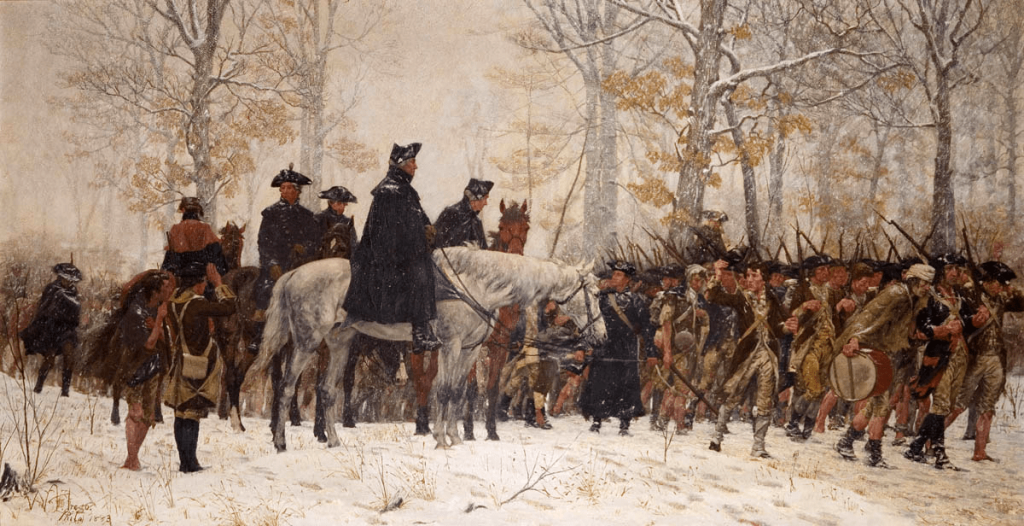
“The March to Valley Forge” by William T. Trego, 1883
SAR Pledge
“We descendants of the heroes of the American Revolution who, by their sacrifices, established the United States of America, reaffirm our faith in the principles of liberty and our Constitutional Republic, and solemnly pledge ourselves to defend them against every foe.”
SAR Recessional
“Until we meet again, let us remember our obligations to our forefathers, who gave us our Constitution, the Bill of Rights, an independent Supreme Court and a nation of free men.”
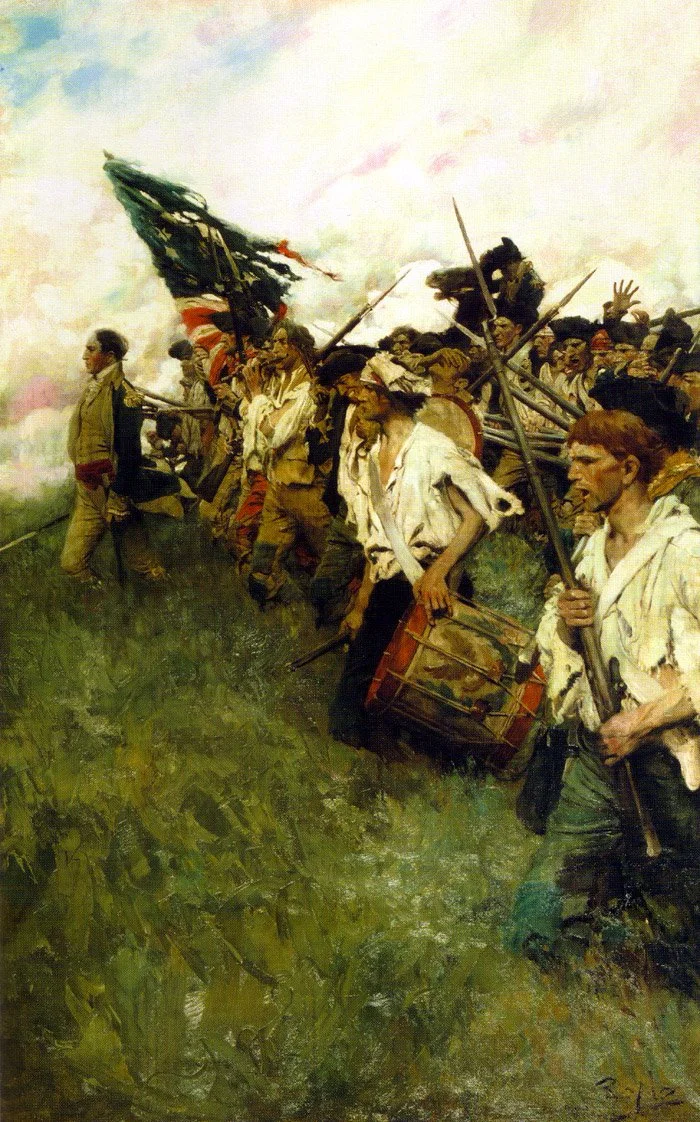
“The Nation Makers” by Howard Pyle, 1906